To understand how the AASL standards and the ISTE standards could work together, I had to understand the framework of each set of standards.
What is ISTE?
Click on the picture below to visit the official ISTE website.
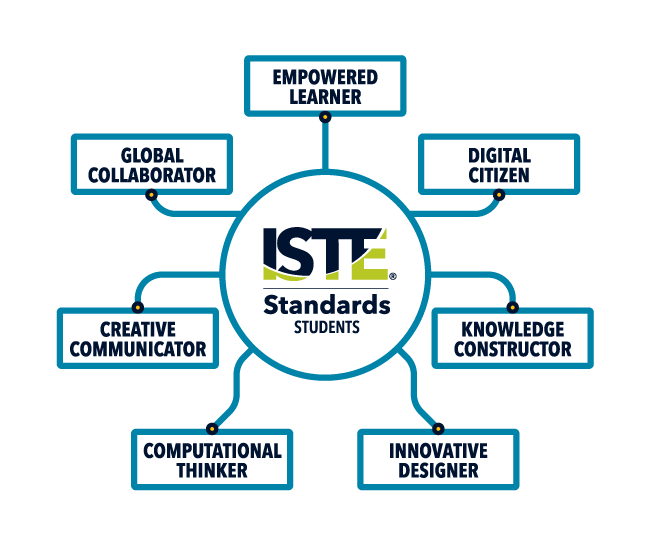
"Today's students must be prepared to thrive in a constantly evolving technological landscape. The ISTE Standards for Students are designed to empower student voice and ensure that learning is a student-driven process" (ISTE, 2021).
What are the AASL Standards?
Click on the picture below to visit the official AASL standards page.
"The National School Library Standards enables personalization for every learner and librarian, allowing you to continuously tailor your school library to your local needs, your our strengths, and learner's benefit" (AASL, 2018).
After I had a clear idea of each set of standards, I needed to see how they could work toghether.
How do the AASL Standards and the ISTE Standards work together?
Click HERE to view how the AASL Standards and the ISTE can work together.
Now that I had a better understanding of both sets of standards and how they can work together, I want to examine an article that was published in the Knowledge Quest journal. I choose to look at the article titled "Now Serving an Appealing Menu of Digital Tools and Resources" by Mary Lou Caron O'Connor. I choose this article because it reminded me of a grammar tool I used when teaching sixth grade. This first interesting thing that jumped out at me was the fact that this librarian was merging three sets of standards! Taking her state standards, AASL standards, and ISTE standards and creating a product that caters to your school district is simply awesome. There is so much more to librarianship than I ever knew!
When I first glanced at both sets of standards, I was drawn to the ASSL standards because they are concise and easy to read and understand. The ISTE standards are more detailed and require more brain power to decipher. However, once I dug into them, I can totally see the usefulness of both. To me, the ASSL standards seem to be less formal and more creative. In a technology driven world, I value a good makerspace set up. When reading these standards, I envisioned a library with students freely moving about, exploring different areas of the library, and accessing hands on activities. When I read through the ISTE standards I had a completely different picture. I saw students sitting at tables with laptops and headphones. I do know that it is possible to collaborate and create on a computer, but for kids, I'm partial to the free roaming and exploring method.
In the case of Mrs. O'Conner's author study of John Scieszka, the students were presented with material using a variety of methods. By mixing traditional teaching, hands on activities, and digital platforms, the librarian is able to teach multiple standards simultaneously. Using this lesson, we can see that Mrs. O'Conner was allowing the students to collaborate with each other to create their own Stinky Cheese Man and then digitally reflect on their learning. And just like that these two sets of standards were working together in harmony!
Overall, both sets of standards seem to be valuable to teachers and students alike. They both foster creativity and exploration while being learner centered. AASL standards and the ISTE standards can greatly complement each other in the school library. Allowing students to explore, inquire, and collaborate is essential to building lifelong learners. Adding technology into the process will only strengthen the student’s ability to be relevant in a technology driven society.
Resources
AASL (2018). National School Library Standards Crosswalk with ISTE Standards for Learners and
Educators. AASL. https://standards.aasl.org/wp-content/uploads/2018/08/180828-aasl-standards-
crosswalk-iste.pdf
ISTE (2021). ISTE Standards for Students. ISTE.
https://www.iste.org/standards/iste-standards-for-students
O'Connor, Mary Lou Caron (2019) . Now Serving an Appealing Menu of Digital Tools and Resources.
Knowledge Quest, V47 (5), p17-21.


Crystal,
ReplyDeleteI actually looked at the same article from Knowledge Quest, and I agree that O'Connor was very creative by using menus to meet all of the standards. Currently I am teaching first grade, and I think it would be interesting to see how my students would use a menu to develop entirely different results. After reading your comparison of the AASL and ISTE Standards, I can see how you would picture different environments based on the wording. I'd never thought about it that way! I do think they complement each other, and I'm excited to work with teachers one day to develop a strong curriculum using all of these standards!
Elizabeth Ford
Elizabeth, I think using a menu in a first grade classroom would be an excellent idea! Giving the students a options might make a reluctant learner more excited to try more challenging things.
DeleteI love the two mental images that you shared about how you see the library under each set of standards. Without realizing it, I think I saw it similarly to you! The AASL standards do seem to allow for more creativity in the library, while the ISTE standards seem like they would be more sedentary. I am confident that my opinion on this will change as we learn more about technology in the library throughout this course! Like you also mentioned, both sets of standards are valuable and necessary, so we must learn to embrace both!
ReplyDeleteI am very eager to learn about new technology to use in the classroom also!
DeleteI loved the Stinky Cheese Man activity and when I was reading the article, I was thinking about how I could do the same in my own library. Not only was it covering AASL Standards and ISTE Standards, it was covering Curricular Standards as well. As I started delving into the AASL Standards and the ISTE Standards, I started thinking about how they both fit so flawlessly into the Curricular Standards too. Last year Technology and Library were very separate entities. This summer our Technology teacher and I got together and looked at the standards and decided to do some co-teaching using both sets of standards. I'm really excited to see how this is going to work, although, right now we aren't allowed to mix classes because of Covid so our co-teaching has been put on the back burner for now! So upsetting!
ReplyDeleteThat is a super cool idea!!! I think that it is very interesting how different school districts and schools use librarians. At my kids elementary school, the librarian has nothing to do with school computers and technology. They have a teacher over the computers as well as a computer lab teacher. However, at the middle school, the librarian issues ALL of the student computers! YUCK!
DeleteSorry - I didn't add my name. Library Lady is Robyn Gough
ReplyDelete